Four years after Covid began, downtowns and downtown offices continue to face major challenges.
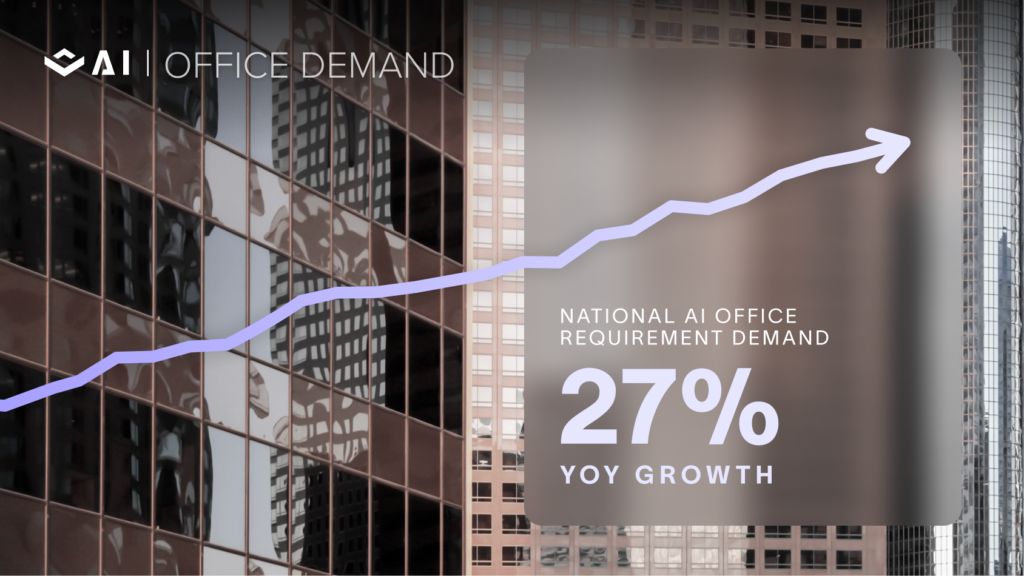
Currently, office vacancy is high, hybrid schedules remain stubborn, and building values are still in flux. The VTS Office Demand Index, for example, has maintained about half to two-thirds of its pre-pandemic level for the last two years. In addition, transit ridership in most cities remains well below 2019 levels, and many transit agencies face a looming fiscal cliff with the expiration of federal relief funds.
Despite this, there’s good reason for hope.
Transit ridership is increasing, emerging industries are still concentrating in downtown cores, and many cities are embracing creative strategies to attract more people. And office space near high-capacity transit is performing well. VTS research found that buildings within five and ten minute walks of transit hubs recently received significantly more tours than buildings further away, with fewer tours on average the further the walk.
The ace up the sleeve for downtowns is the special role of existing transit infrastructure. Far from crisis, downtowns are actually well-positioned for the future.
Today is different than post-WWII suburbanization
To some, the current challenges of downtown seems comparable to the post-WWII era of suburbanization, when central city populations declined and downtowns’ share of regional office space and jobs plummeted.
At that time, most cities mistakenly embraced the automobile as the solution and allowed highways to tear through neighborhoods, displacing hundreds of thousands of residents, while encircling downtowns with a spaghetti of new roads in what were once viable neighborhoods.
But transit endured, and so did downtowns. Some regions added new transit in subsequent decades, often to prioritize suburban commuters (much to the chagrin of urban residents). And despite decades of suburbanization and prioritization of highway investment, downtowns boomed again. From 2000 to 2010, downtowns in metropolitan regions greater than 1 million grew significantly faster than their surrounding county or metropolitan region, reversing the opposite trend in prior decades.
While some observers cannot see past the current atmosphere and challenges, we believe that history echoes and that the past endurance of downtowns and transit holds some lessons for the future.
A key part of downtowns’ value proposition is transit. The existing transit infrastructure – subways, street cars, light rail, even ferries – built to support commuting to and from the central business district also makes downtown, and particularly buildings near transit, the region’s most accessible place.
That’s good for office owners because you cannot move an office building and you (generally) cannot move a rail line. We believe that over the next several decades, downtowns with significant rail transit infrastructure today will have an enduring advantage that will actually grow over time.
Why?
- First, it’s exceedingly hard to build new transportation infrastructure in the U.S.
- Second, it’s also exceedingly hard to build new dense mixed-use centers. That means downtowns will face fewer competitors.
- Third, downtown transit is key to achieving climate goals as it allows people to get around without driving. Climate priorities are likely to compel policy ever more powerfully in the coming years.
Transit infrastructure gives downtowns and the buildings close to them a huge advantage.
In most metropolitan regions, the place with the greatest transit infrastructure and highest transit ridership is the region’s primary downtown or central business district. This resulted from the concentration of rail lines into downtowns in the early and mid 20th century, including Chicago’s L, the subways under Lower Manhattan, San Francisco’s Ferry Building and street cars up and down Market Street and post WWII BART.
Today, Lower Manhattan has 3 million jobs within a 30 minute transit commute (most of those within Lower Manhattan or Midtown), and Downtown Los Angeles has nearly 1.2 million jobs within 30 minutes. No other place in the region compares.
3 Reasons Downtown Transit is a Critical Asset
1. The Prohibitive Cost of New Infrastructure
Building new transit in the U.S. has become increasingly difficult. While cities like Paris and Madrid can build for a fraction of the cost, U.S. projects in New York and the Bay Area often exceed $1.3 billion per kilometer. This high barrier ensures that established transit-rich downtowns face almost no new geographic competitors. The infrastructure in place today is a permanent advantage for the future.
2. Density and Scarcity of Mixed-Use Centers
According to research by Brookings Metro, dense activity centers account for only 3% of land but 40% of jobs. There is a fundamental "geometry of success" in downtowns: high-volume talent pools cannot move into a walkable area without rail. Because it is exceedingly hard to build new dense, mixed-use centers, existing downtowns remain the only viable hubs for large-scale economic activity.
3. The Climate and ESG Mandate
With global commitments to transition away from fossil fuels, transportation is under heavy scrutiny as the largest source of U.S. greenhouse gas emissions. In hubs like Seattle, D.C., and San Francisco, walking or transit is the norm. To meet 2035 climate goals, regions must reduce overall driving by 25%—a goal that the California Air Resources Board notes can only be met by utilizing the high-capacity transit found in downtown cores. This aligns with the COP28 agreement signaling the global transition toward sustainable travel.
What This Means for the Office Market: "Couch vs. Core"
In 2026, the main competitor to the downtown office is no longer the suburban office park—it is the home office (the "couch").
Suburban job centers are struggling with increased congestion and fewer commuting options. Conversely, functioning transit allows downtowns to remain accessible to a wide range of people. To navigate these shifts, many owners are turning to VTS Lease and VTS Data to track demand in real-time.
Key Observations for 2026:
- The Transit Premium: Buildings near high-capacity hubs are seeing a rebound in tour activity that outpaces the broader market.
- Operational Focus: Cities are shifting toward "the basics," improving service frequency and cleanliness. Solutions like VTS Activate are helping managers bridge the gap between transit and the desk.
- Location as Value: Office space integrated with transit is becoming more important as policies make driving more expensive and less convenient.
Frequently Asked Questions
1. How does transit proximity affect office building value?
Properties within a 5-10 minute walk of a transit hub see higher tenant demand. Research indicates that tour volume declines as the distance from a rail or subway station increases, making transit proximity a main driver of building liquidity.
2. Why isn't the current "urban crisis" like 1950s suburbanization?
In the 1950s, cities tried to solve growth issues with highways that displaced residents. Today, the "infrastructure moat" of rail and the scarcity of walkable, high-density areas mean downtowns have no real regional peers.
3. What role does transit play in meeting CRE climate goals?
To meet ESG (Environmental, Social, and Governance) targets, regions must reduce total vehicle miles traveled. Downtowns are the only areas with the infrastructure to support large employment hubs without relying on fossil-fuel-intensive driving, making them more "future-proof" for institutional investors. Organizations can manage these complexities across sectors using VTS Retail or industrial portfolio tools.
Issi Romem and Egon Terplan are contributing authors to VTS. Issi is an economist and the founder of MetroSight. Egon is a Senior Advisor at MetroSight.